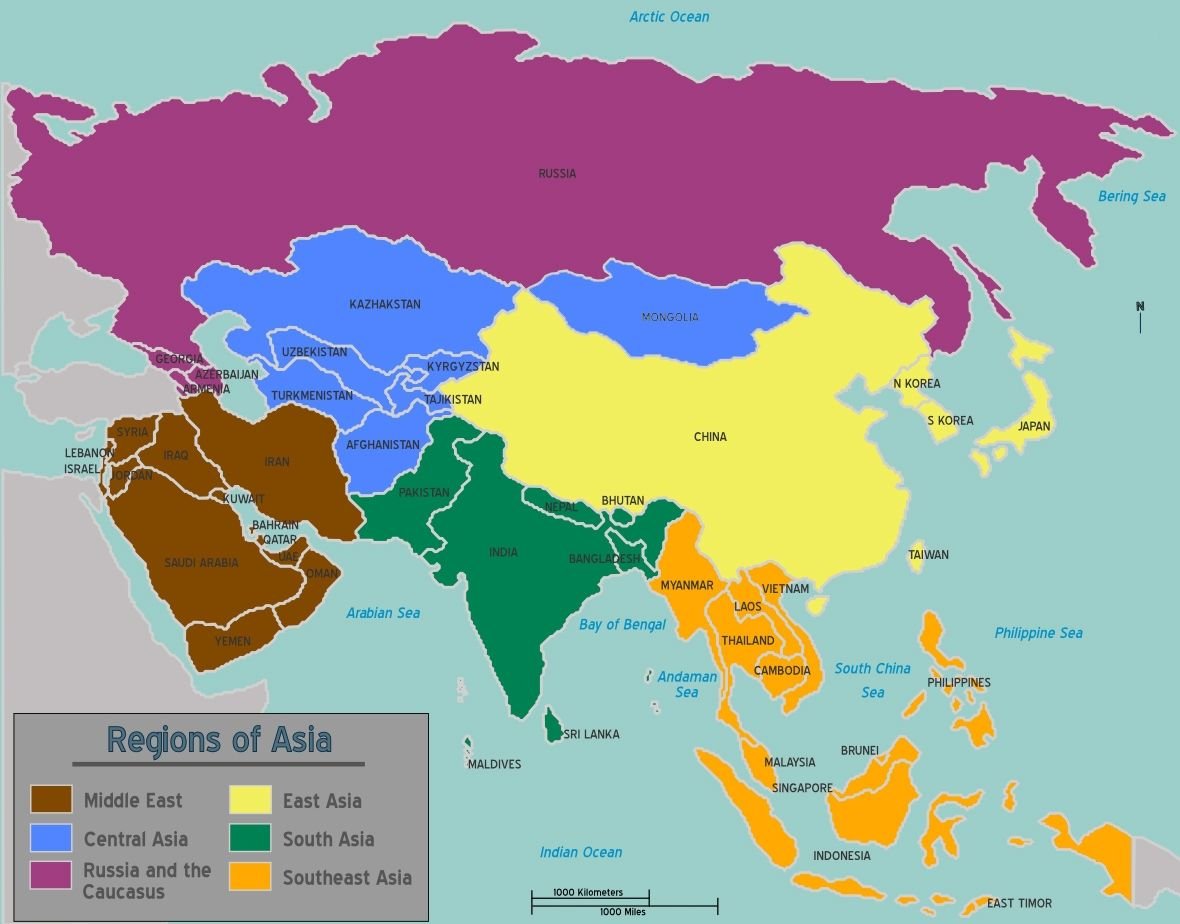
Asia is the world’s largest and most populous continent, stretching from the Mediterranean and Middle East in the west to the Pacific Ocean in the east, and from Siberia in the north to the Indian Ocean and Southeast Asian islands in the south.
For geographic, cultural, historical, and tourism purposes, Asia is commonly divided into six major regions:
1. East Asia
East Asia includes the countries and territories around the western Pacific and eastern edge of the Asian continent.
Countries and territories commonly included:
- China
- Japan
- Mongolia
- North Korea
- South Korea
- Taiwan
Major cities: Beijing, Shanghai, Tokyo, Osaka, Seoul, Pyongyang, Ulaanbaatar, Taipei
Characteristics: East Asia has some of the world’s oldest civilizations and includes major economic and technological centers. Chinese, Japanese, and Korean cultures have had enormous historical influence across Asia.
Major attractions: Great Wall of China, Forbidden City, Mount Fuji, Kyoto, Terracotta Army, Gobi Desert, Jeju Island.
2. Southeast Asia
Southeast Asia lies between East Asia, South Asia and Oceania. It consists of both mainland and island countries.
Mainland Southeast Asia
- Cambodia
- Laos
- Myanmar
- Thailand
- Vietnam
Maritime Southeast Asia
- Brunei
- Indonesia
- Malaysia
- Philippines
- Singapore
- Timor-Leste
Major cities: Bangkok, Hanoi, Ho Chi Minh City, Jakarta, Manila, Singapore, Kuala Lumpur, Phnom Penh
Characteristics: The region is known for tropical climates, extensive coastlines, islands, rainforests, ancient civilizations and highly diverse cultures and religions.
Major attractions: Angkor Wat, Bali, Ha Long Bay, Borobudur, Philippine islands, Singapore, Phuket, Luang Prabang.
3. South Asia
South Asia occupies the Indian subcontinent and surrounding areas.
Countries commonly included:
- Afghanistan
- Bangladesh
- Bhutan
- India
- Maldives
- Nepal
- Pakistan
- Sri Lanka
Major cities: New Delhi, Mumbai, Dhaka, Karachi, Lahore, Kathmandu, Colombo, Islamabad, Malé
Characteristics: South Asia contains enormous linguistic, cultural and religious diversity. It is home to the Himalayas, the Indian subcontinent’s great river systems and some of the world’s oldest civilizations.
Major attractions: Taj Mahal, Himalayas, Everest region, Varanasi, Sigiriya, Maldives, Kathmandu Valley, Rajasthan.
4. Central Asia
Central Asia is the landlocked heart of the Asian continent and historically formed an important part of the Silk Road.
Countries:
- Kazakhstan
- Kyrgyzstan
- Tajikistan
- Turkmenistan
- Uzbekistan
Major cities: Astana, Almaty, Bishkek, Dushanbe, Ashgabat, Tashkent, Samarkand
Characteristics: Central Asia is characterized by vast steppes, deserts, high mountains and historic trading cities. The region has strong Turkic, Persian and nomadic cultural influences.
Major attractions: Samarkand, Registan Square, Pamir Mountains, Tian Shan Mountains, Karakum Desert, Charyn Canyon, Issyk-Kul.
5. Western Asia
Western Asia is often referred to as West Asia and overlaps substantially with what is commonly called the Middle East.
Countries commonly included:
- Armenia
- Azerbaijan
- Bahrain
- Cyprus
- Georgia
- Iraq
- Israel
- Jordan
- Kuwait
- Lebanon
- Oman
- Palestine
- Qatar
- Saudi Arabia
- Syria
- Turkey
- United Arab Emirates
- Yemen
Major cities: Istanbul, Riyadh, Dubai, Abu Dhabi, Doha, Jerusalem, Baghdad, Beirut, Amman, Tbilisi, Baku, Muscat
Characteristics: Western Asia connects Europe, Africa and the rest of Asia. It contains some of the world’s oldest urban civilizations and important historical centers of Judaism, Christianity and Islam.
Major attractions: Cappadocia, Petra, Burj Khalifa, ancient Jerusalem, Hagia Sophia, Wadi Rum, Persepolis, Arabian Peninsula deserts and the Caucasus.
6. Northern Asia
Northern Asia is dominated geographically by Siberia and the Russian Far East.
Main area:
- Asian Russia
Major cities: Novosibirsk, Yekaterinburg, Irkutsk, Krasnoyarsk, Yakutsk, Vladivostok
Characteristics: Northern Asia has enormous forests, tundra, mountains, rivers and permanently or seasonally frozen landscapes. It contains some of the most sparsely populated areas on Earth.
Major attractions: Lake Baikal, Trans-Siberian Railway, Altai Mountains, Kamchatka Peninsula, Lena Pillars and Siberian taiga.
Asia’s Six Main Regions at a Glance
| Region | Main Countries/Areas | Geographic Character |
|---|---|---|
| East Asia | China, Japan, Korea, Mongolia, Taiwan | Pacific coast, mountains, plains |
| Southeast Asia | Thailand, Vietnam, Indonesia, Philippines, etc. | Tropical islands, rainforests, mainland river valleys |
| South Asia | India, Pakistan, Bangladesh, Nepal, Sri Lanka, etc. | Indian subcontinent, Himalayas |
| Central Asia | Kazakhstan, Uzbekistan, Kyrgyzstan, Tajikistan, Turkmenistan | Steppes, deserts, mountains |
| Western Asia | Turkey, Saudi Arabia, Iran-adjacent areas, Caucasus, Levant, Gulf states, etc. | Middle East, Caucasus, Anatolia, Arabian Peninsula |
| Northern Asia | Asian Russia/Siberia | Taiga, tundra, mountains, Arctic |
Other geographic classifications
There is no single universally accepted division of Asia. Different organizations use slightly different boundaries. For example, the United Nations geoscheme divides Asia into Western Asia, Central Asia, Southern Asia, Eastern Asia and South-eastern Asia, while Northern Asia is generally represented by the Russian Federation within broader statistical classifications.
Leave a Reply
You must be logged in to post a comment.